
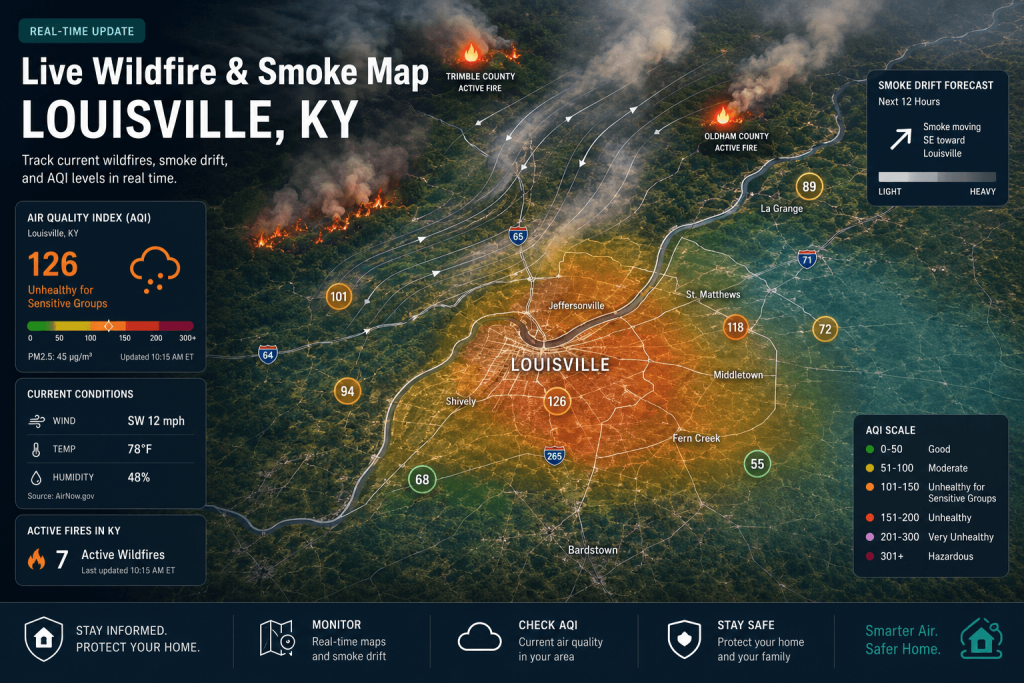
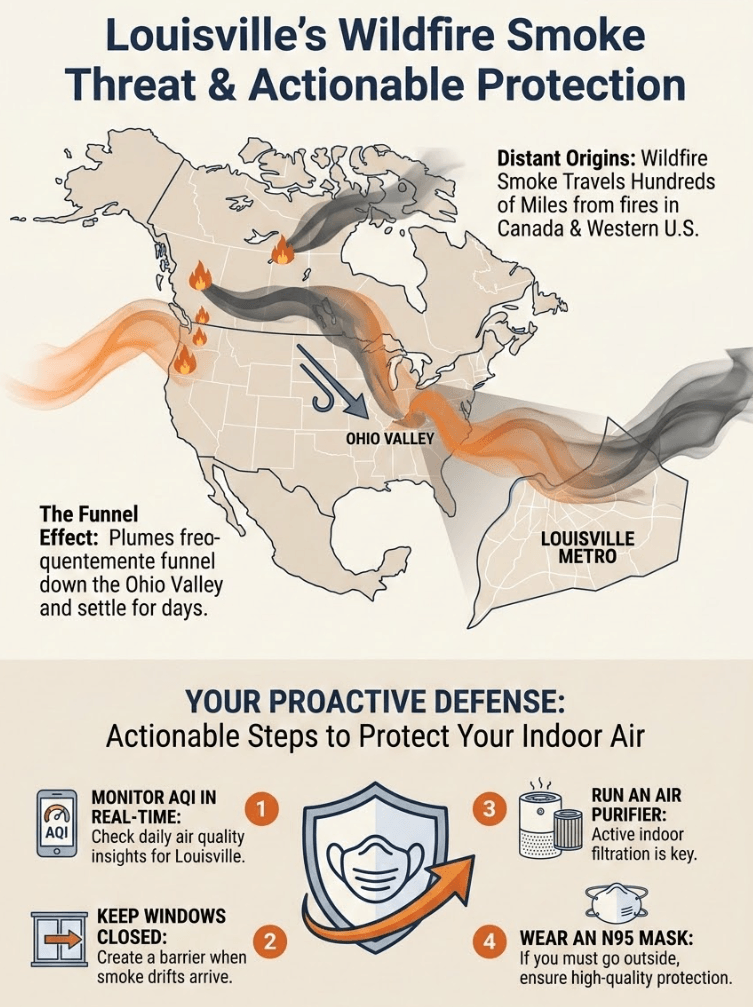
In recent summers, the haze that dimmed Louisville’s skyline didn’t start anywhere near Kentucky. It drifted in from wildfires burning hundreds of miles north in Canada, funneled down the Ohio Valley, and settled over the city for days. That is the wildfire most Louisville families need to watch: the kind you don’t see coming, only breathe. The map on this page tracks active fires and smoke drift across the region in real time, next to the current Air Quality Index (AQI) for Louisville and Jefferson County.
Most days, Louisville’s air sits in the good-to-moderate range. When it doesn’t, this page helps you read what’s happening, understand what the number means for your household, and keep the air inside your home clean.
TL;DR Quick Answers
Current live forest wildfire and smoke map today in Louisville, KY
Track Louisville’s wildfire smoke and air quality in real time on the AirNow Fire and Smoke Map (fire.airnow.gov), which layers active fires, smoke plumes, and live AQI readings over Jefferson County. Most days Louisville’s air stays in the good-to-moderate range. Readings climb mainly when smoke drifts in from distant fires, not from flames near the city.
- Where to check now: the AirNow Fire and Smoke Map (built by the EPA and U.S. Forest Service) and the Louisville Air Watch monitors from Louisville Metro APCD.
- What’s normal here: Louisville rarely sees local wildfires. Hazy air usually means smoke that traveled in from Canada or the western U.S.
- Read the number: an AQI below 100 is fine for most people. At 101 and up, children, older adults, and anyone with heart or lung conditions should ease off outdoor activity.
- On a smoky day: keep windows shut, set your HVAC fan to recirculate, and filter the indoor air with a MERV 13 filter or a HEPA purifier.
- Stay ahead of it: sign up for free EnviroFlash alerts so you know before the smoke arrives.
Top takeaways
- Louisville’s wildfire risk is mostly about smoke that drifts in from far away, not fire at your doorstep.
- The AQI runs from 0 to 500. Anything below 100 is acceptable for most people.
- Wildfire smoke is mostly PM2.5, particles small enough to reach deep into your lungs.
- Children, older adults, pregnant women, and anyone with heart or lung conditions feel it first.
- A few practical habits at home make a measurable difference on smoky days.
Table of Contents
How to read the live map
The map layers a few kinds of information over the Louisville area. Flame icons show where fires are burning. Gray shading traces the smoke moving off them. The colored dots are air quality monitors, each shaded to match its AQI category, from green for good air to maroon for hazardous.
The EPA and the U.S. Forest Service built this tool, the AirNow Fire and Smoke Map, and it folds in local Louisville monitors too. Smoke shifts fast with the wind, so check it again later in the day instead of trusting one morning glance.
What today’s AQI means
The Air Quality Index turns pollution levels into one number on a 0-to-500 scale. The Louisville Metro Air Pollution Control District posts a local reading four times each weekday, and anything under 100 counts as acceptable for public health.
Here is the short version. From 0–50 (green), the air is clean. From 51–100 (yellow), it’s acceptable, though unusually sensitive people may feel it. Once the number reaches 101–150 (orange), children, older adults, and anyone with heart or lung trouble should cut back on outdoor time. At 151 and up, the air turns unhealthy for everyone, and Louisville usually has an alert out by then. On smoky days, the pollutant behind these numbers is almost always fine particle pollution, or PM2.5.
Does Louisville actually get wildfires?
Large forest fires at the city’s edge are rare. Most of what reaches Louisville is smoke that traveled in from somewhere else. It helps to know what wildfires are and how they spread, but for our area the part that matters is the smoke they push downwind, sometimes from Canada, sometimes from fires out West.
Kentucky still has its own fire seasons. State law sets a spring forest fire hazard season from February 15–April 30 and a fall season from October 1–December 15, and it restricts daytime burning near woodland during those windows. Smoke from regional brush and debris fires can foul local air then, especially on dry, windy days.
How wildfire smoke affects your health
Wildfire smoke is a mix of gases and fine particles. PM2.5 is the part that does the most harm, because particles that small slip deep into your lungs and even into your bloodstream. On a smoky day, you might get itchy eyes, a scratchy throat, a cough, or a headache.
Some people feel it sooner and harder: children, older adults, pregnant women, and anyone living with asthma, COPD, or heart disease. If that’s you or someone under your roof, watch the AQI. Keep activity light when the number climbs, and move workouts indoors until the air clears.
How to protect your home and family on a smoky day
The goal is to keep smoke out and the indoor air clean. Shut your windows and doors, and set the HVAC fan to recirculate instead of pulling in outside air. Hold off on anything that adds particles inside, like burning candles or frying on the stove.
Filtration does the heavy lifting. A higher-rated furnace filter, MERV 13 if your system can handle the airflow, traps far more fine particles than a basic one. A portable purifier with a true HEPA filter works well in whatever room your family uses most. If you’re not sure which filter suits your system, this guide to choosing the right MERV-rated furnace filter for smoke is a solid place to start.
For the worst stretches, pick one room you can close off, run a purifier in it, and treat it as your clean-air space. If you head outside, a well-fitted N95 or KN95 helps. A cloth or surgical mask does little against particles this fine. It’s also a good moment to confirm the smoke alarms in your home still work. For more on staying ahead of smoke and fire at home, see our smoke and wildfire guides.
“After following Louisville’s air through a few summers of drifting wildfire smoke, I’ve learned the haze that sneaks in on a calm day deserves more attention than most people give it. Checking the AQI before you head out, and filtering the air at home, is the most dependable protection I’ve seen work.”
Seven essential resources
Bookmark these official tools to track smoke, air quality, and fire activity around Louisville. Every one comes straight from the agency that generates the data.
- AirNow Fire and Smoke Map (EPA and U.S. Forest Service). The live national map of fires, smoke plumes, and ground-level air quality.
- Louisville Metro Air Pollution Control District: current air quality. Local AQI readings and the Louisville Air Watch monitoring network, straight from the city.
- EnviroFlash air quality alerts. Free email and text alerts that warn you the night before local air is forecast to turn unhealthy.
- National Weather Service, Louisville (air quality and fire weather). Short-term AQI forecasts and the fire-weather conditions that move smoke into the Ohio Valley.
- CDC: staying safe during a wildfire. Health guidance on smoke exposure and how to set up a clean-air room at home.
- Kentucky Division of Forestry: wildland fire management. State fire hazard seasons and the outdoor burning rules that shape local smoke.
- National Interagency Fire Center: National Fire News. A daily rundown of major wildfires across the country, often the source of drifting smoke.
Three statistics worth knowing
PM2.5 particles measure 2.5 micrometers or less. For scale, a single human hair runs about 70 micrometers wide, roughly 30 times bigger than the largest fine particle. That size is exactly why smoke slips past your body’s defenses and reaches deep into your lungs. Source: U.S. EPA, Particulate Matter Basics.
About 176,359 children in Kentucky are breathing unhealthy levels of air pollution, according to the American Lung Association’s 2026 “State of the Air” report. That’s a concrete reason to take ozone and particle pollution seriously, and to keep younger family members inside when the AQI climbs. Source: American Lung Association, State of the Air (Kentucky).
Around 99% of Kentucky’s wildfires are caused by people, according to Kentucky Emergency Management. Because most are preventable, careful burning and campfire habits protect your property and the air your neighbors breathe. Source: Kentucky Emergency Management, wildfire preparation.
Final thoughts and opinion
Here’s our honest read. As wildfire seasons stretch longer across North America, Louisville will keep catching smoky days, and that’s worth taking seriously. It’s still a manageable problem, not a reason to dread every gray sky.
The households that ride out smoke season well tend to share one habit. They check the AQI the way they check the forecast, and they keep one room ready with clean air. Do that, and a smoky stretch turns into an inconvenience rather than a health scare. That’s what this page is for: enough to act on, without the fear.
Frequently asked questions
Is the air safe to breathe in Louisville today?
Check the live AQI on the map above for the current reading. As a rule of thumb, anything below 100 is fine for most people. Once it passes 100, children, older adults, and people with heart or lung conditions should limit time outdoors.
How do I check real-time air quality in Louisville, KY?
Use the AirNow Fire and Smoke Map or the Louisville Air Watch monitors from the Air Pollution Control District. Both refresh through the day. The free AirNow app puts the same readings on your phone, which helps when conditions change fast.
What AQI level is dangerous?
From 101 to 150, the air is unhealthy for sensitive groups. At 151 and above, it’s unhealthy for everyone. At those levels, limit outdoor activity, keep windows shut, and run filtered air inside. Louisville issues an alert once the forecast reaches 101 or higher.
Does Louisville, Kentucky get wildfires?
Large wildfires at the city’s edge are rare. The bigger issue is smoke that drifts in from distant fires in Canada and the western United States, plus regional brush and debris fires during Kentucky’s spring and fall fire hazard seasons.
What air filter should I use for wildfire smoke?
Look for a filter rated to catch fine particles. A MERV 13 furnace filter works well if your HVAC system can handle the airflow, and a portable purifier with a true HEPA filter is a strong pick for a single room. Match the filter to your system and room size.
How long does wildfire smoke last in Louisville?
It depends on how active the fires are and which way the wind blows. Some smoke events clear in a day. Others hang around for several. Watch the National Weather Service forecast and the AQI so you know when the air is improving.
Know Before The Smoke Arrives
Don’t wait for the next hazy morning to wonder whether it’s safe outside. Sign up for free Louisville air quality alerts through EnviroFlash, and you’ll know before the smoke arrives. For more on keeping your home’s air clean year-round, browse our latest guides.